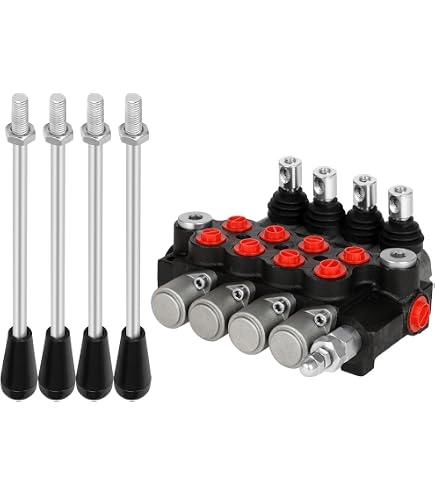
Hydraulic valves are fundamental to fluid power systems, controlling pressure, flow, and the movement of hydraulic actuators. Standard hydraulic valves are widely used because they are readily available and designed for common operating conditions, but specialized machinery may require a different approach.
A customized hydraulic control valve is developed or modified to meet the specific requirements of a hydraulic circuit. Compared with a standard valve, it can provide greater flexibility in areas such as dimensions, port arrangements, pressure ratings, flow characteristics, actuation, and installation requirements.
What Are Standard Hydraulic Valves?
Standard hydraulic valves are manufactured according to established specifications and commonly used configurations. They are available in various types, sizes, pressure ratings, and control arrangements.
For many general-purpose systems, standard valves provide a practical solution without requiring additional engineering or design work. Their established designs can also simplify sourcing and replacement.
However, their predefined specifications may create limitations when equipment has unusual hydraulic or mechanical requirements.
What Is a Customized Hydraulic Valve?
A customized hydraulic valve is designed around the needs of a particular application. Depending on the project, customization can involve a minor modification to an existing valve or the development of a more application-specific configuration.
Possible adjustments include valve body dimensions, port locations, mounting patterns, internal components, control methods, sealing materials, and performance characteristics.
The objective is to achieve the required function while maintaining compatibility with the complete hydraulic system.
Standard vs. Custom: Key Differences
The choice between standard and customized valves depends largely on how closely available products match the machine’s requirements.
| Consideration | Standard Hydraulic Valve | Customized Hydraulic Valve |
|---|---|---|
| Design | Predefined configuration | Adapted to application requirements |
| Availability | Usually readily available | May require development and production |
| Dimensions | Fixed options | Can be modified |
| Port arrangement | Standard configurations | Can be application-specific |
| Pressure and flow | Predetermined ranges | Can be designed around requirements |
| Installation | Suitable for compatible systems | Can accommodate unusual layouts |
| Development time | Generally shorter | Usually requires engineering time |
| Initial cost | Often lower | Can be higher |
| Flexibility | Limited to available specifications | Greater design flexibility |
Neither option is universally better. The appropriate choice depends on the application’s technical and commercial priorities.
When Standard Valves Make Sense
Standard valves are often the preferred option when the hydraulic system follows conventional specifications. They can be especially suitable for straightforward applications where pressure, flow, dimensions, and connection types align with readily available products.
Their established designs can also make replacement easier. If a valve fails, an equivalent standard component may be easier to identify and source.
For high-volume maintenance operations, this availability can be an important practical advantage.
When Customization Becomes Necessary
Customization may become appropriate when no standard valve satisfies the required combination of specifications.
Typical situations include:
- Limited installation space
- Unusual port configurations
- Non-standard mounting requirements
- Specialized pressure or flow conditions
- Integration with existing equipment
- Specific actuation requirements
- Harsh environmental conditions
- Specialized control sequences
In these cases, forcing a standard valve into the system may require additional adapters, fittings, structural changes, or other modifications.
Installation and System Integration
Installation compatibility is one of the clearest differences between standard and customized valves.
A standard valve may have suitable hydraulic performance but incompatible dimensions or connection locations. This can require changes to hoses, mounting brackets, manifolds, or other components.
A custom valve can be designed around the existing installation. Matching the physical and hydraulic interfaces can simplify integration and reduce unnecessary changes elsewhere in the machine.
Performance Considerations
Standard valves generally provide predictable performance within their specified operating range. This makes them suitable for applications that fit those specifications.
Custom valves can be developed around particular performance targets. Flow characteristics, pressure control, response behavior, and actuation can be considered according to the machine’s operating cycle.
This can be useful for equipment that requires controlled movement, synchronized operation, or specific hydraulic responses.
Cost Comparison
Initial purchase price is an important consideration, but it should not be the only factor in the decision.
Standard valves typically have lower initial costs because they are manufactured in established configurations and larger quantities. A custom valve may require engineering, prototyping, specialized machining, or additional testing.
However, a standard valve that requires several adapters or modifications can increase the total system cost. The more appropriate comparison is therefore the overall cost of installation, integration, operation, and maintenance.
Lead Time and Availability
Standard valves generally have an advantage when immediate availability is important. Common models can often be sourced through established distribution channels.
Custom valves typically require additional development and manufacturing time. The exact lead time depends on design complexity, material requirements, production quantity, testing, and other project factors.
For this reason, custom solutions are often better suited to applications where technical compatibility is more important than immediate component availability.
Maintenance and Replacement
Standard valves can simplify maintenance because replacement models may be readily identifiable. Maintenance teams may already be familiar with commonly used configurations.
Customized valves require more careful documentation. Technical drawings, specifications, part numbers, and maintenance information should be retained so that future replacements or repairs can be completed accurately.
For equipment expected to operate for many years, serviceability should be considered during the initial custom design.
Reliability and Application Fit
Reliability depends on more than whether a valve is standard or customized. Correct sizing, material selection, installation, operating conditions, maintenance, and hydraulic circuit design all influence valve performance.
A standard valve that is correctly selected for its application can provide dependable service. Likewise, a custom valve can offer reliable performance when it is properly engineered, manufactured, and tested.
The key factor is whether the valve is appropriately matched to the system.
How to Choose Between the Two
The decision can begin with a review of the hydraulic system’s requirements.
Consider the following questions:
- Does an available standard valve meet the required pressure and flow ratings?
- Are its dimensions compatible with the available installation space?
- Do the ports and mounting points match the existing equipment?
- Is its actuation method suitable for the control system?
- Are the material and sealing options appropriate?
- Would additional adapters or modifications be required?
- Is the expected production volume sufficient to justify customization?
- How important are lead time and immediate availability?
If a standard valve satisfies these requirements without significant modification, it may be the more practical option. If several important requirements cannot be met, customization deserves closer consideration.
Customization Does Not Always Mean Complete Redesign
It is important to recognize that customization can range from a simple modification to a highly specialized valve design.
For example, an application may only require a different port orientation or mounting pattern. Another project may require changes to internal flow paths, pressure control, actuation, and materials.
The scope of customization should be proportional to the actual engineering requirement.
Conclusion
The choice between a standard hydraulic valve and a customized solution depends on the complexity and requirements of the hydraulic system. Standard valves are often advantageous for conventional applications because of their availability, established specifications, and potentially lower initial cost.
Customized valves become more valuable when equipment requires unusual dimensions, connection arrangements, pressure and flow characteristics, control methods, or environmental resistance. Rather than choosing based solely on purchase price, engineers should evaluate compatibility, integration, performance, maintenance, lead time, and total system cost.
A careful comparison of these factors can help determine whether an existing standard valve is sufficient or whether a custom configuration is the more appropriate engineering solution.