The packaging industry is undergoing significant changes as manufacturers adopt advanced technologies to improve production efficiency, product protection, and operational flexibility. Growing consumer expectations, increasing production demands, labor challenges, and sustainability concerns are encouraging businesses to modernize their packaging processes. As a result, manufacturers are exploring new equipment and intelligent systems that can make packaging operations more accurate, connected, and adaptable.
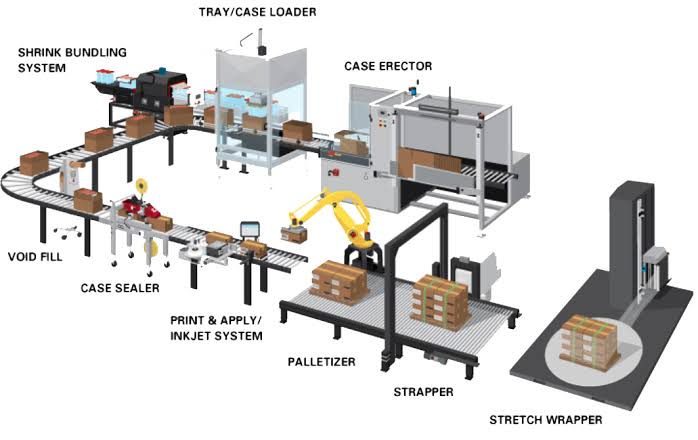
Modern Automated Packaging Lines are evolving beyond traditional machinery that performs individual tasks. Today’s systems increasingly combine robotics, artificial intelligence, smart sensors, digital controls, and connected monitoring technologies to coordinate multiple packaging stages. Understanding these developments helps manufacturers prepare for future production requirements and identify technologies that may improve their operations.
1. Artificial Intelligence in Packaging Automation
Artificial intelligence (AI) is becoming an important technology in modern manufacturing. It allows machines and software systems to analyze operational information, recognize patterns, and support more informed production decisions.
In packaging facilities, AI can be applied to quality inspection, equipment monitoring, production planning, and process optimization.
For example, AI-powered vision systems can examine packages for visible defects, incorrect labels, damaged containers, and missing components. These systems analyze images and compare product characteristics against predefined quality requirements.
AI can also help manufacturers identify recurring production problems by examining historical machine data. This may allow operators to recognize patterns associated with packaging defects or equipment performance changes.
As AI technologies develop, their role in packaging quality management and operational decision-making is expected to expand.
2. Growth of Industrial Robotics
Robotics is transforming repetitive packaging activities that traditionally require considerable manual effort.
Industrial robots can perform tasks such as:
- Picking products from production conveyors.
- Placing items into cartons.
- Loading and unloading packaging materials.
- Sorting products according to specifications.
- Palletizing finished packages.
- Handling products during secondary packaging.
Robotic systems offer repeatable movements and can operate at consistent speeds when properly configured.
Manufacturers are also using robots for applications that require precise positioning or the handling of heavy products. This helps reduce repetitive physical workloads and supports more organized production environments.
Future robotic systems are likely to become more adaptable, allowing manufacturers to handle different product formats with less manual adjustment.
3. Collaborative Robots in Packaging Facilities
Collaborative robots, commonly called cobots, are designed to work alongside human employees in suitable manufacturing environments.
Unlike many traditional industrial robots that operate within dedicated safety enclosures, collaborative systems can be designed for applications involving closer human interaction.
Cobots may assist with carton loading, product sorting, packaging preparation, and other repetitive activities.
Their compact designs and flexible programming can make them useful for small and medium-sized manufacturers that need automation without installing large robotic systems.
However, collaborative applications still require appropriate risk assessments, safety configurations, and operator training.
As cobot technology advances, it may become easier for manufacturers to automate selected tasks while retaining human involvement in quality checks and specialized handling.
4. Internet of Things and Connected Packaging Equipment
The Industrial Internet of Things (IIoT) connects machines, sensors, and control systems so they can exchange operational information.
In packaging facilities, connected equipment can provide information about machine speed, production quantities, operating temperatures, equipment status, and maintenance requirements.
This connectivity helps production teams monitor different packaging stations from centralized systems.
For example, if a conveyor begins operating below its expected speed, monitoring software may alert operators before the issue affects the entire production line.
Connected equipment can also improve communication between filling, sealing, labeling, and packaging machines.
As industrial connectivity develops, manufacturers will have more opportunities to coordinate production activities and respond quickly to operational changes.
5. Predictive Maintenance and Intelligent Monitoring
Traditional maintenance programs often rely on scheduled inspections or repairs after equipment failures occur.
Predictive maintenance uses machine condition data to estimate when components may require attention. Sensors can monitor vibration, temperature, pressure, and other operating conditions to identify unusual behavior.
This approach can help maintenance teams detect potential problems before they cause major equipment failures.
For example, unusual vibration in a conveyor motor may indicate a developing mechanical issue. Addressing it early can help prevent an unexpected production interruption.
Predictive maintenance can offer several advantages:
- Reduced unplanned downtime.
- Better maintenance scheduling.
- Improved equipment reliability.
- More efficient spare parts planning.
- Longer component service life.
Its effectiveness depends on suitable sensors, reliable data, accurate analysis, and trained maintenance personnel.
6. Advanced Machine Vision for Quality Inspection
Product inspection is an essential part of packaging quality management. Manufacturers need to identify damaged containers, missing labels, incorrect closures, and other defects before finished products reach customers.
Traditional inspection may rely on employees checking packages manually or using basic detection equipment.
Advanced machine vision systems use cameras, image-processing software, and AI technologies to inspect products automatically.
These systems can examine label placement, package appearance, cap positioning, product orientation, and other visible characteristics.
Some solutions can inspect products at high production speeds while recording information about detected defects.
As camera technology and image-processing capabilities improve, automated inspection is expected to become more detailed and adaptable.
7. Flexible and Modular Packaging Systems
Product variety is increasing across many industries. Manufacturers may need to package different container sizes, product types, and packaging formats within the same facility.
Traditional production lines can require significant mechanical adjustments when changing between products.
Modular packaging systems provide an alternative by allowing manufacturers to configure or expand equipment according to production needs.
A modular system may include interchangeable filling units, adjustable conveyors, replaceable labeling heads, and additional inspection stations.
This approach can make product changeovers easier and allow businesses to expand production capacity gradually.
Flexible equipment is particularly useful for manufacturers that manage multiple product lines or experience changing seasonal demand.
8. Digital Twins and Virtual Production Simulation
Digital twin technology creates a virtual representation of a physical machine, production line, or manufacturing facility.
The digital model can use operational data to represent how equipment performs under different conditions.
In packaging operations, manufacturers may use digital twins to examine production layouts, evaluate equipment configurations, and simulate possible process changes.
For example, a company planning to install a new labeling machine can use simulation tools to study how the equipment may affect conveyor movement and production capacity.
This can help identify potential bottlenecks before making physical changes.
Digital simulation may also support operator training, maintenance planning, and production optimization.
Although implementation can require specialized software and data integration, digital twins offer useful opportunities for complex manufacturing environments.
9. Sustainable Packaging and Material Reduction
Environmental responsibility is becoming an important consideration for manufacturers and packaging suppliers.
Businesses are exploring ways to reduce packaging waste, improve material utilization, and adopt recyclable or reusable packaging formats.
Automation can support these objectives by improving material handling and reducing certain production errors.
For example, accurate filling systems can help minimize product overfilling, while controlled packaging equipment can reduce defects caused by inconsistent material application.
Future packaging machinery may also offer greater compatibility with lightweight materials, recyclable films, paper-based packaging, and alternative container designs.
However, manufacturers must test new materials carefully because their thickness, flexibility, strength, and sealing characteristics may differ from conventional packaging materials.
10. Energy-Efficient Packaging Machinery
Energy consumption is an important factor in manufacturing operating costs.
Packaging equipment uses electricity for motors, conveyors, compressors, heaters, control systems, and other components. Inefficient machinery can increase energy expenses over time.
New equipment designs are increasingly focused on improving energy efficiency through optimized motor systems, variable-frequency drives, improved insulation, and more efficient operating controls.
Manufacturers can also use monitoring software to identify equipment that consumes excessive energy.
For example, production teams may adjust conveyor speeds according to actual requirements or shut down selected equipment during extended periods of inactivity.
Energy-efficient machinery can help businesses manage operating costs while supporting broader sustainability objectives.
11. Smart Filling and Dosing Technologies
Filling accuracy is essential for manufacturers handling liquids, powders, granules, and other products.
Traditional filling systems may require frequent adjustments when product characteristics change or production requirements vary.
Smart filling technologies use sensors, electronic controls, and advanced dispensing mechanisms to maintain more consistent quantities.
Depending on the application, these systems may use flow meters, load cells, piston mechanisms, or auger-based dosing equipment.
Some advanced solutions can store product-specific settings, making it easier to switch between different filling requirements.
Improvements in measurement and control technology are expected to support more precise filling processes and reduce unnecessary material waste.
12. Advanced Packaging Data Analytics
Manufacturers generate large amounts of information during packaging operations. This includes production counts, machine speeds, downtime records, rejection rates, material usage, and maintenance information.
Data analytics tools help transform this information into useful performance insights.
Production managers can use dashboards to monitor key indicators such as:
- Overall equipment effectiveness (OEE).
- Production output per shift.
- Packaging defect rates.
- Machine availability.
- Changeover duration.
- Material consumption.
- Maintenance frequency.
Analyzing these indicators helps manufacturers understand where production problems occur and which improvements may provide the greatest benefits.
Future analytics systems may also provide more advanced recommendations based on historical production patterns and real-time machine information.
13. Cloud-Based Manufacturing Management
Cloud technology allows manufacturing information to be stored and accessed through internet-connected platforms.
For packaging facilities with multiple production locations, cloud-based systems can make it easier to review equipment performance and compare operational results.
Managers may access production reports, maintenance information, and equipment status without being physically present at every packaging station.
Cloud platforms can also support communication between production planning, inventory management, and manufacturing systems.
However, businesses must consider cybersecurity, data protection, network reliability, and access controls when adopting cloud-based solutions.
14. Augmented Reality for Maintenance and Training
Augmented reality (AR) is another technology with potential applications in packaging operations.
AR tools can display digital instructions, diagrams, and equipment information over a user’s view of physical machinery.
Maintenance technicians may use AR-supported devices to follow repair instructions or identify specific machine components.
Similarly, new operators can receive visual guidance when learning how to configure equipment or complete routine maintenance activities.
These tools may help simplify technical training and improve access to equipment documentation.
Their practical value depends on the complexity of the machinery, available digital content, and employee familiarity with the technology.
15. Greater Integration Between Packaging and Supply Chain Systems
Packaging operations do not function independently from the rest of a manufacturing business. They are connected to inventory management, production planning, warehousing, transportation, and distribution.
Future manufacturing environments are likely to place greater emphasis on integrating packaging equipment with enterprise resource planning (ERP) and manufacturing execution systems (MES).
This integration can help businesses coordinate production schedules, monitor material availability, and track finished goods.
For example, packaging operations may receive production information based on customer orders and available inventory.
Better information exchange can reduce scheduling conflicts and help manufacturers respond more effectively to changing demand.
16. Improved Traceability and Smart Identification
Product traceability is increasingly important in industries where accurate identification and recordkeeping are essential.
Automated coding and labeling equipment can apply batch numbers, manufacturing dates, expiration dates, and other product information.
Future packaging systems may combine barcode technology, QR codes, RFID tags, and connected databases to provide more detailed product tracking.
These technologies can support inventory management, product recalls, quality investigations, and supply chain visibility.
Manufacturers should select identification solutions according to their industry requirements, product characteristics, and applicable regulations.
17. Human-Machine Collaboration and Workforce Development
As packaging systems become more advanced, employees will increasingly work alongside automated equipment rather than performing every task manually.
Operators may supervise machine performance, review digital dashboards, manage product changeovers, and conduct quality checks.
Maintenance personnel will also need stronger knowledge of sensors, control systems, robotics, and connected equipment.
This shift makes workforce development an important part of automation planning.
Manufacturers should invest in practical training, technical education, and clear operating procedures to help employees adapt to changing production environments.
How Manufacturers Can Prepare for Future Packaging Innovations
Adopting new technology requires careful planning. Not every innovation is suitable for every production facility, and unnecessary complexity can increase costs.
Manufacturers can prepare for future developments by following several practical steps:
- Evaluate existing operations: Identify production bottlenecks, recurring packaging defects, and equipment limitations.
- Define business objectives: Determine whether the main priority is higher output, better quality, lower waste, or improved flexibility.
- Assess technology compatibility: Confirm that new equipment can integrate with existing machinery and control systems.
- Consider scalability: Choose solutions that can accommodate future production changes.
- Train employees: Prepare operators and technicians to work with advanced automation technologies.
- Review maintenance requirements: Understand the technical support, spare parts, and servicing needed for new equipment.
- Measure performance: Compare production data before and after introducing new technologies.
A gradual approach allows manufacturers to introduce improvements while managing investment and operational risks.
Conclusion
The automated packaging industry is moving toward more intelligent, connected, flexible, and sustainable production systems. Artificial intelligence, robotics, machine vision, IIoT connectivity, predictive maintenance, and digital twins are creating new opportunities to improve packaging performance.
At the same time, modular machinery, energy-efficient equipment, and advanced data analytics are helping manufacturers respond to changing production requirements. Successful adoption will depend on selecting suitable technologies, maintaining equipment properly, and preparing employees for increasingly digital manufacturing environments.
Businesses researching modern packaging systems and future automation opportunities can explore the equipment solutions offered by Techflow Pack as part of their efforts to develop more efficient and adaptable packaging operations.