Inflatable sports games have become popular attractions at school sports days, corporate gatherings, community festivals, birthday parties, and promotional events. They combine familiar sporting activities with colorful inflatable structures, interactive challenges, and friendly competition. From soccer target games to basketball shooting contests and inflatable obstacle courses, these attractions offer entertainment for participants with different interests and skill levels.
For event organizers, entertainment venues, and rental businesses, Inflatable Sports Games provide flexible options for creating engaging activities and encouraging group participation. Different designs serve different purposes, so understanding the most popular types can help buyers select equipment that suits their audience, available space, and budget. This guide explores common inflatable sports games, their features, and the events where they can be most useful.
What Are Inflatable Sports Games?
Inflatable sports games are recreational attractions that use inflatable structures to create sports-inspired activities and interactive challenges. They may feature goals, hoops, targets, barriers, playing areas, or obstacle sections, depending on the product design.
Many models are designed for temporary installation, allowing event organizers to set them up for a specific occasion and pack them away afterward. Some are compact enough for small gatherings, while others require larger outdoor spaces and more extensive setup arrangements.
Unlike conventional sports facilities, inflatable games often simplify traditional activities into short, accessible challenges. Participants might aim at a target, score points by shooting a ball, complete an obstacle course, or compete in timed rounds.
The appropriate game depends on the intended audience, participant capacity, installation conditions, and manufacturer’s operating instructions.
1. Inflatable Soccer Games
<PRIVATE_PERSON> Inflatable soccer games are popular because they combine a familiar sport with simple challenges that can be enjoyed in recreational settings. They are commonly used at school events, football-themed parties, community festivals, and corporate sports days.
Popular Soccer Game Formats
Soccer target challenges: These games feature target openings or scoring zones. Players kick a ball toward a designated area and earn points based on accuracy.
Inflatable soccer goals: These provide a defined goal area for shooting challenges, penalty competitions, or simple recreational matches, depending on the design.
Soccer darts-style games: Some attractions use a large target surface and compatible balls to create a scoring challenge inspired by darts.
Soccer skill challenges: Certain designs focus on shooting accuracy, ball control, or other simple skills that can be organized into individual or team competitions.
Why Choose Inflatable Soccer Games?
Soccer games can be suitable for participants who enjoy football but may not have access to a full playing field. Organizers can create short rounds, establish team scores, or hold friendly accuracy competitions.
They can also be adapted to promotional events by incorporating team colors, sponsor graphics, or branded designs where customization is available.
Before choosing a model, check its dimensions, permitted ball type, anchoring requirements, and intended participant group.
2. Inflatable Basketball Games
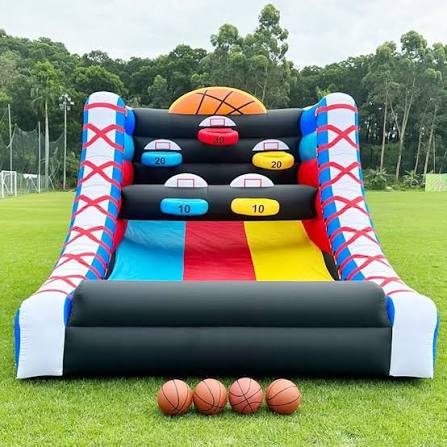
Inflatable basketball games bring shooting challenges into temporary event spaces. They typically feature one or more hoops, designated shooting positions, and a scoring format that encourages participants to test their accuracy.
Common Basketball Game Options
Basketball shooting challenges: Players attempt to score as many baskets as possible within a set time or number of attempts.
Dual-hoop competitions: Some designs allow two participants to compete simultaneously, creating a straightforward head-to-head challenge.
Team scoring games: Participants take turns shooting, and their scores contribute to a combined team total.
Branded basketball attractions: Businesses and event organizers may choose customized graphics to match a sports event, company campaign, or school theme.
Where Are Basketball Games Used?
These inflatables can work well at school fairs, corporate picnics, shopping center promotions, family festivals, and birthday celebrations. The rules are generally easy to explain, which helps organizers manage activities with frequent participant changes.
When selecting a basketball inflatable, consider the available space, hoop height, number of players allowed, ball-return features if included, and the manufacturer’s instructions for safe use.
3. Inflatable Obstacle Courses
Inflatable obstacle courses add a more physical and competitive element to sports-themed entertainment. Depending on the design, they may include tunnels, climbing sections, barriers, crawl-through areas, and slides.
Participants usually attempt to complete the course, sometimes racing against one another or competing for the best time.
Benefits of Inflatable Obstacle Courses
Obstacle courses can support group competitions and relay activities. Teams may take turns completing the course, combining individual performances into a shared score.
They can also accommodate different event themes, from school sports days to company team-building programs and community festivals.
However, obstacle courses generally need more installation space than small target games. Buyers should review the overall footprint, participant flow, surface requirements, supervision needs, and operating limits before purchasing.
4. Inflatable Baseball and Throwing Games
Inflatable baseball-inspired games and throwing challenges focus on accuracy, coordination, and target-based competition. Depending on the model, participants may throw a suitable ball toward designated targets or aim for marked scoring zones.
These games are often useful for sports festivals, school carnivals, community gatherings, and promotional events where organizers want a short activity that can accommodate many participants throughout the day.
What Makes These Games Appealing?
Target-based challenges are relatively easy to organize. Players can take turns, collect points, and compare results without needing to participate in a full-length sports match.
Some designs may also be customized with team graphics or event branding. Buyers should confirm the approved throwing equipment and ensure that spectators remain outside the active playing area.
5. Inflatable Bowling Games
Inflatable bowling offers a recreational version of traditional bowling using oversized inflatable pins and suitable throwing or rolling equipment.
The game usually involves knocking down as many pins as possible in a set number of attempts. Its simple objective makes it easy to introduce at family gatherings, school fairs, community events, and indoor entertainment programs.
Key Features to Consider
When evaluating inflatable bowling games, consider the size of the playing area, the type of ball supplied or recommended, the stability of the pins, and the number of participants who can take turns efficiently.
Organizers should provide a clear throwing zone and keep waiting participants away from the active play area. The equipment should be used only as intended by the manufacturer.
6. Inflatable Volleyball and Net Games
Some inflatable sports attractions are designed around volleyball-inspired play or net-based challenges. Their specific layouts vary, so buyers should check whether a product is intended for casual ball games, target activities, or another form of recreation.
These games can be suitable for family events, school activities, and outdoor gatherings where participants want a group-based activity.
Advantages of Net-Based Inflatable Games
Net games can encourage communication, coordination, and cooperation. Participants may work together to keep a rally going or compete in friendly rounds, depending on the design.
Before choosing one, confirm the required playing area, net dimensions, suitable ball type, and whether the attraction is appropriate for the intended age group.
7. Inflatable Multi-Sport Games
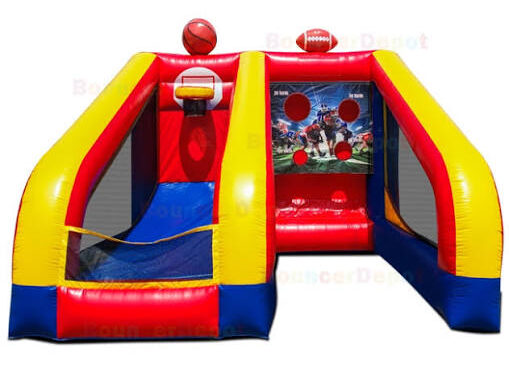
Multi-sport inflatables combine several activities in one attraction or provide different challenges within the same event setup. A product may include football target practice, basketball shooting, throwing challenges, or other sports-inspired features.
Why Consider a Multi-Sport Design?
A multi-sport game can appeal to a broader audience because participants can choose activities that match their interests. It may also help rental businesses offer more variety without transporting a separate large inflatable for every sport.
These designs can be particularly useful at festivals, school events, corporate gatherings, and community celebrations.
However, the term “multi-sport” can describe very different products. Review the specific features, dimensions, included accessories, setup requirements, and participant capacity before making a decision.
8. Inflatable Sumo and Physical Challenge Games
Some inflatable sports attractions focus on playful physical challenges rather than traditional ball sports. These may include designated competition areas or activities designed around balance, movement, and friendly contests.
Certain products use specialized protective equipment, while others feature different formats. The exact rules and safety requirements depend on the design.
These games may appeal to corporate events, adult parties, festivals, and team-building activities. Organizers should check the manufacturer’s instructions, permitted participants, supervision requirements, and protective equipment specifications.
Never assume that a soft inflatable surface eliminates the risk of injury. Activities involving physical contact require particular care and must be operated only in accordance with the product’s intended use.
9. Inflatable Target and Accuracy Games
Target games are among the more versatile options for sports-themed events. They may involve kicking, throwing, or shooting a suitable ball toward designated openings or scoring zones.
These attractions can provide short individual challenges or team competitions. Their relatively straightforward rules can make them suitable for events with a continuous flow of visitors.
Examples of Target-Based Challenges
- Football accuracy games with marked scoring areas.
- Basketball shooting targets.
- Ball-throwing challenges with different point values.
- Sports-themed targets for timed competitions.
When comparing models, check the type of ball or equipment required, scoring layout, installation space, and how the game accommodates spectators and waiting participants.
10. Inflatable Racing and Relay Games
Inflatable racing games and relay-style challenges are designed to encourage movement and friendly competition. Depending on the product, they may involve completing a sequence of obstacles, reaching a target, or taking turns as part of a team.
Relays can be particularly useful when an event organizer wants to involve several participants rather than focus on individual performance.
For example, a company could arrange a team competition in which each participant completes a short challenge and contributes to the group’s overall result.
Organizers should set clear rules, keep activity areas organized, and select games suitable for the participants’ ages and physical abilities.
How to Choose the Right Inflatable Sports Game
The most suitable inflatable depends on the purpose of the event, the audience, and the practical conditions at the installation site.
Consider the Target Audience
Think about who will participate. A school event may need activities suitable for children, while a corporate gathering may benefit from a mixture of skill-based challenges and team competitions.
Review the manufacturer’s age guidance and restrictions. Choose a game that provides an appropriate challenge without encouraging participants to exceed their abilities.
Measure the Available Space
Check the inflatable’s full dimensions and allow additional room for anchoring, entrances, exits, movement, and supervision.
Indoor venues also require sufficient ceiling height and suitable access for moving the packed equipment into position. Outdoor locations need appropriate ground conditions and enough room for safe installation.
Evaluate Construction Quality
Review the materials, seam construction, reinforcement, blower specifications, and included accessories. Ask the supplier about quality-control procedures, inspection documentation, warranty terms, and replacement parts.
A detailed assessment of construction and support is more useful than relying only on appearance or promotional claims.
Compare Setup and Transportation Requirements
Larger inflatables may require a delivery vehicle, multiple workers, and additional time for installation and packing. Check the packed weight and dimensions before buying.
Consider whether the equipment can be transported and stored using your existing resources. These requirements are especially important for rental businesses that handle several bookings each week.
Set a Realistic Budget
The purchase price is only one part of the total cost. Shipping, accessories, storage, cleaning, repairs, staffing, insurance, and electricity may add to the overall expense.
Rental operators should also estimate realistic demand and potential booking frequency. A less expensive game may not provide good value if it attracts limited interest or is difficult to operate.
Safety Tips for Inflatable Sports Games
Safe operation should remain a priority regardless of the type of game selected.
Follow Manufacturer Instructions
Install the inflatable according to the supplied instructions, including the specified anchoring system, blower setup, clearances, and operating conditions.
Do not use improvised installation methods or modify the equipment without appropriate authorization.
Inspect Before Each Use
Check the material, seams, anchor points, blower, electrical connections, and accessories before allowing participants to enter.
If you find damage that could affect safe operation, stop using the equipment until it has been assessed and properly repaired.
Observe Weather Restrictions
Outdoor inflatables may need to be shut down during strong winds, lightning, heavy rain, or other conditions outside the manufacturer’s operating limits.
Establish a clear procedure for monitoring weather and stopping activities when required.
Manage Participants and Spectators
Follow the stated participant limits and age restrictions. Explain the rules, provide suitable supervision, and prevent overcrowding.
For target and throwing games, keep spectators away from the active area. For obstacle courses and physical challenges, ensure participants understand the correct direction of movement and any restrictions.
Maintain the Equipment
Clean the inflatable after use, allow it to dry completely, and store it in a protected environment. Regularly inspect the material and accessories, and arrange repairs when necessary.
Consistent maintenance helps reduce avoidable damage and supports reliable operation at future events.
Conclusion
Popular inflatable sports games include soccer target challenges, basketball shooting attractions, obstacle courses, baseball-inspired throwing games, inflatable bowling, net-based games, multi-sport designs, and other interactive competitions. Each type offers different benefits, from individual skill challenges to team-based activities and physical obstacle races.
Choosing the right option requires an understanding of the audience, event objectives, available space, construction quality, transportation needs, and budget. Safety, proper installation, and regular maintenance are equally important for keeping the attraction suitable for repeated use.
By comparing the available designs and assessing their practical requirements, event organizers and rental businesses can select inflatable sports games that encourage participation, create memorable experiences, and fit their operational needs.