Introduction
Choosing the right food packaging is essential for restaurants, cafes, catering companies, and takeaway businesses. Different meals have different packaging requirements, depending on their ingredients, portion sizes, moisture levels, and serving temperatures. A container that works well for a dry rice dish may not be suitable for a salad with dressing or a meal containing several sauces.
Bento-style packaging offers a practical way to organize multiple food components in one container. When evaluating Takeaway Bento Boxes, businesses should consider the type of food being served, the number of compartments needed, material strength, and transportation conditions. Selecting the right design helps maintain food presentation while making takeaway orders easier to handle.
1. Understand the Requirements of Each Meal
The first step is to identify the characteristics of the food you plan to package. Different ingredients can affect the container’s performance in different ways.
For example, dry foods generally require less moisture protection than dishes containing sauces or dressings. Hot meals may need packaging designed to tolerate higher temperatures, while chilled foods require containers suitable for refrigerated storage.
Before selecting a bento box, consider:
- Whether the food is hot, cold, dry, oily, or moist.
- How many separate ingredients the meal contains.
- Whether sauces need their own compartments.
- The expected portion size.
- How long the food will remain inside the container.
- Whether the meal will be collected or delivered.
These details help narrow down the most suitable packaging options.
2. Choose the Right Bento Boxes for Rice and Main Courses
Rice meals are common in restaurants and takeaway menus. They are often served with vegetables, meat, seafood, eggs, or other side dishes.
For these meals, a bento box with two or more compartments can help keep the main portion separate from accompanying ingredients.
A larger section can accommodate rice or noodles, while smaller sections can hold proteins and vegetables. This arrangement helps maintain a neat presentation and prevents ingredients from becoming unnecessarily mixed.
When choosing a container for rice meals, consider its overall capacity, structural strength, and ability to retain its shape during transportation.
3. Select Suitable Containers for Salads
Salads often contain fresh vegetables, fruits, proteins, toppings, and dressings. Keeping these ingredients organized can help maintain their appearance.
A bento box with separate sections is useful for salads containing crunchy toppings, nuts, cheese, or fruit. These ingredients can be kept apart until the meal is ready to eat.
For salads with dressing, businesses should consider a container with an appropriate separate sauce compartment or use a compatible sealed dressing cup.
The material should also be suitable for chilled food storage and resistant to moisture from fresh ingredients.
4. Consider Packaging for Fried and Oily Foods
Fried foods such as chicken, fries, spring rolls, and other crispy snacks require careful packaging.
Excessive moisture can affect their texture, while oil can weaken certain paper-based materials if they lack suitable protective treatments.
When selecting a bento box for fried food, evaluate:
- Grease resistance of the packaging material.
- Ventilation and moisture management.
- Container strength under the weight of the food.
- Compartment size for separating different items.
- Compatibility with the intended serving temperature.
Some fried foods benefit from packaging designs that allow steam to escape rather than trapping excessive moisture. The best structure depends on the specific menu and delivery conditions.
5. Choose Appropriate Bento Boxes for Saucy Dishes
Meals containing gravy, curry, dressings, or other liquid ingredients need packaging with suitable leak protection.
A container with well-defined compartments may help separate sauces from rice, bread, or other ingredients. However, compartments alone do not guarantee leak resistance.
Businesses should check whether the container has a suitable barrier, secure lid, and construction designed for the intended food. For liquid-heavy dishes, a separate sealed container may be more appropriate.
Testing with actual menu items is especially important before purchasing large quantities.
6. Match Compartment Layouts to Meal Combinations
The number and arrangement of compartments influence how conveniently a meal can be packed and served.
Different meal combinations may require different layouts.
Single-Compartment Designs
These containers are suitable for meals that do not require ingredient separation, such as pasta dishes, rice bowls, or larger portions of a single food item.
Two-Compartment Designs
Two sections can separate a main dish from a side item. They are useful for meals containing rice and vegetables, sandwiches and snacks, or similar combinations.
Three-Compartment Designs
Three sections offer more flexibility for complete meals containing a main course and two accompanying items.
Multiple-Compartment Designs
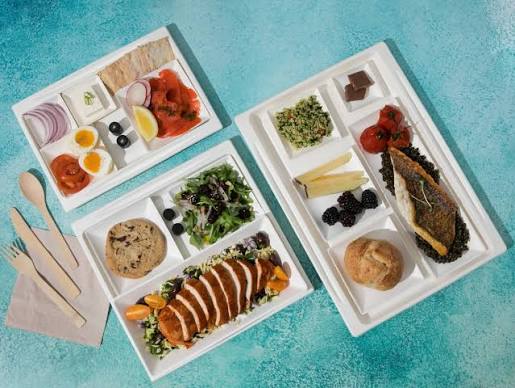
Containers with several sections are useful for balanced meals, tasting combinations, and menus containing many small portions.
Choose a layout that fits the actual food portions rather than selecting the largest number of compartments available.
7. Evaluate Material Options
Bento boxes are manufactured using different materials, and each has its own characteristics.
Cardboard and Paperboard
Paper-based containers are lightweight and offer various printing and customization possibilities. They are commonly considered by restaurants looking for fiber-based takeaway packaging.
However, their performance depends on thickness, construction, and protective coatings. Businesses should check moisture and grease resistance when using them for wet or oily dishes.
Plastic
Plastic containers are available in rigid and flexible designs. They can provide useful moisture resistance, and some feature transparent lids for food visibility.
Buyers should verify that the material is suitable for the intended food-contact and temperature conditions.
Molded Fiber and Other Plant-Based Materials
Some bento-style containers are made from molded fiber or other plant-based materials. Their strength, surface characteristics, and resistance to moisture vary according to their composition.
Businesses should review product specifications rather than assuming that all fiber-based containers have the same performance.
8. Check Size and Portion Capacity
The dimensions of a bento box should match the amount of food being served.
A container that is too small may compress ingredients or make the meal difficult to close. An oversized design may create unnecessary empty space and affect presentation.
Restaurants should compare the internal dimensions of different containers and consider how much space each food component requires.
It is also useful to test containers with standard menu portions to establish consistent packaging sizes.
9. Consider Temperature and Food Safety Requirements
Temperature compatibility is an important factor when choosing takeaway packaging.
Some containers are designed for hot meals, while others are intended for chilled or room-temperature food. Businesses should confirm the manufacturer’s stated temperature limits and intended applications.
Microwave or freezer compatibility should never be assumed based only on appearance or material type.
Food businesses must also ensure that packaging meets relevant food-contact safety requirements and is handled in a hygienic environment.
10. Pay Attention to Lid and Closure Design
A suitable closure helps protect food during storage and transportation.
Depending on the product, bento boxes may use folding flaps, attached lids, tuck-in closures, or separate covers.
When evaluating closure performance, consider:
- Whether the lid fits securely.
- Whether the container can be opened easily.
- Whether the closure remains intact during delivery.
- Whether the design can support normal stacking.
- Whether the package is suitable for the weight of the food.
A practical closure should protect the meal without making the packaging difficult for staff or customers to handle.
11. Choose Packaging That Supports Food Presentation
Packaging is part of the overall meal experience. A well-arranged container can make food appear more organized and appealing.
Restaurants can use separate compartments to highlight different ingredients, colors, and textures. Transparent lids may also be useful when food visibility is important.
For paper-based packaging, printed designs and brand colors can create a consistent appearance across takeaway orders.
The packaging design should complement the food rather than distract from it.
12. Consider Delivery and Storage Conditions
The best container for dine-in takeaway collection may not always be the best option for longer delivery journeys.
Delivery packaging should be evaluated for structural strength, closure security, stacking performance, and resistance to movement.
Businesses should also consider how empty containers will be stored. Stackable designs can help organize packaging inventory and make better use of available storage space.
Testing packaging under realistic delivery conditions can reveal issues that may not appear during a simple kitchen inspection.
13. Avoid Common Mistakes When Selecting Bento Boxes
Choosing packaging based only on price or appearance can create problems later.
Some common mistakes include:
- Ignoring food moisture: Wet ingredients may require specialized barriers or separate compartments.
- Choosing unsuitable dimensions: Incorrect sizing can affect portion presentation and container performance.
- Overlooking grease resistance: Oily foods may damage packaging without suitable protective properties.
- Assuming all containers are microwave-safe: Temperature compatibility must be confirmed by the manufacturer.
- Neglecting delivery tests: Packaging should be checked under normal transportation conditions.
- Ordering large quantities without samples: Testing samples first helps identify quality or design problems.
A careful selection process can reduce packaging waste, operational inconvenience, and customer complaints.
14. Work with a Reliable Packaging Supplier
A dependable supplier can help food businesses identify suitable container designs for their menus and operating requirements.
When comparing suppliers, review their material choices, product dimensions, customization services, quality control procedures, production capacity, and delivery schedules.
Request samples and confirm technical details before placing a bulk order. Businesses may also compare available options from Uchampak when evaluating bento-style packaging for different takeaway applications.
Clear specifications help both the buyer and manufacturer understand the required container structure, material performance, and printing details.
Conclusion
Choosing the best takeaway bento boxes for different meals requires more than selecting an attractive container. Restaurants and food delivery businesses should evaluate food characteristics, compartment layouts, material quality, portion capacity, closure performance, and transportation conditions.
Rice meals, salads, fried foods, and saucy dishes each have different packaging needs. Matching the container design to these requirements can help preserve food presentation, improve handling, and create a more convenient customer experience.
By testing samples and working with a reliable packaging supplier, businesses can select bento boxes that support their menus and day-to-day food service operations.