Industrial facilities that use multiple solvents in manufacturing, coating, printing, cleaning, chemical processing, and pharmaceutical production often generate exhaust streams containing different volatile organic compounds (VOCs). These compounds can vary in concentration, boiling point, chemical reactivity, odor characteristics, and treatment requirements. Designing an effective treatment solution therefore requires more than selecting a standard air pollution control device.
A well-designed Voc Treatment System For Mixed Solvents should account for the composition and variability of the exhaust, the required emission limits, operating conditions, and the characteristics of the selected treatment technology. A systematic engineering approach helps facilities control emissions, maintain stable operation, and manage energy and maintenance costs.
Understanding VOC Emissions From Mixed Solvents
Mixed-solvent exhaust contains two or more organic compounds released during industrial operations. Common sources include solvent-based coatings, adhesives, inks, degreasing agents, cleaning chemicals, and chemical production processes.
Depending on the application, emissions may contain compounds such as:
- Alcohols, including ethanol and isopropanol.
- Ketones, such as acetone and methyl ethyl ketone.
- Aromatic hydrocarbons, including toluene and xylene.
- Esters used in coatings, printing, and adhesives.
- Aliphatic hydrocarbons used in cleaning and manufacturing.
- Other process-specific organic compounds.
Each solvent has different physical and chemical properties. Some compounds are readily adsorbed by activated carbon, while others may require different treatment conditions. Certain mixtures can also contain substances that interfere with catalysts or create safety concerns.
For this reason, identifying the actual composition of the exhaust is the first step in designing a suitable treatment system.
Step 1: Conduct a Detailed VOC Emission Assessment
A treatment system should be based on reliable process data rather than estimated emissions alone. Facilities should evaluate the exhaust from each significant production source before selecting equipment.
Identify Solvent Types and Concentrations
Determine which solvents are present and estimate their individual concentrations. A total VOC measurement can provide useful information, but it may not reveal important differences between compounds.
Where necessary, laboratory analysis or appropriate monitoring methods can help establish the composition of the exhaust.
Measure Exhaust Airflow
Airflow determines the size of fans, ductwork, treatment equipment, and other system components. Measurements should account for normal production, peak operations, and periods when several processes operate simultaneously.
Evaluate Temperature and Humidity
Exhaust temperature and moisture content can influence adsorption, condensation, filtration, and oxidation performance. High humidity, for example, may affect the capacity of some activated carbon systems.
Assess Operating Patterns
Some facilities produce continuous exhaust, while others generate emissions in batches. Production schedules, equipment startup, cleaning cycles, and shutdown periods can all affect VOC loading.
A complete assessment should document:
- Individual solvent compounds.
- Total VOC concentration.
- Exhaust airflow and temperature.
- Relative humidity.
- Emission fluctuations.
- Particulate and aerosol content.
- Operating hours and production schedules.
- Applicable emission requirements.
This information forms the basis of equipment selection and system sizing.
Step 2: Evaluate Safety Risks Associated With Solvent Mixtures
Mixed-solvent exhaust can create fire, explosion, and chemical exposure risks. These hazards must be considered before designing ductwork, fans, storage arrangements, and treatment equipment.
Understand Flammability Limits
Many organic solvents are flammable. Their concentrations in air should be evaluated against relevant flammability limits and applicable safety requirements.
The system design should consider the possibility of changing VOC concentrations during production fluctuations, equipment cleaning, and abnormal operating conditions.
Identify Chemical Compatibility Issues
Some solvent mixtures may contain compounds that react with one another or with treatment materials. Others may contain substances that affect activated carbon or catalyst performance.
The manufacturer and process safety team should evaluate chemical compatibility before finalizing the treatment method.
Provide Appropriate Monitoring and Protection
Depending on the process risk assessment, safety measures may include:
- VOC or combustible gas monitoring.
- Temperature and pressure monitoring.
- Suitable ventilation and dilution arrangements.
- Explosion prevention or protection measures.
- Emergency shutdown systems.
- Electrical equipment appropriate for the classified area.
- Fire detection and suppression provisions where required.
Safety arrangements should follow applicable regulations and engineering standards. They should not rely on dilution or monitoring alone where additional protection is necessary.
Step 3: Select the Appropriate VOC Treatment Technology
No single technology is suitable for every mixed-solvent application. The correct choice depends on the compounds present, exhaust volume, concentration, operating pattern, recovery opportunities, and treatment targets.
Activated Carbon Adsorption
Activated carbon systems capture VOC molecules on the surface and within the pore structure of the carbon material.
They can be suitable for certain solvent-containing exhaust streams, particularly where concentrations and airflow are within the design limits of the equipment.
Important considerations include:
- Carbon type and adsorption capacity.
- Compatibility with individual solvent compounds.
- Humidity and exhaust temperature.
- Potential for competitive adsorption.
- Carbon replacement or regeneration requirements.
- Fire risk and temperature monitoring.
Mixed solvents may compete for adsorption sites, so the capacity of activated carbon cannot be determined from total VOC concentration alone.
Zeolite Rotor Concentration
Zeolite rotor systems are often considered for applications with large exhaust volumes and relatively low VOC concentrations.
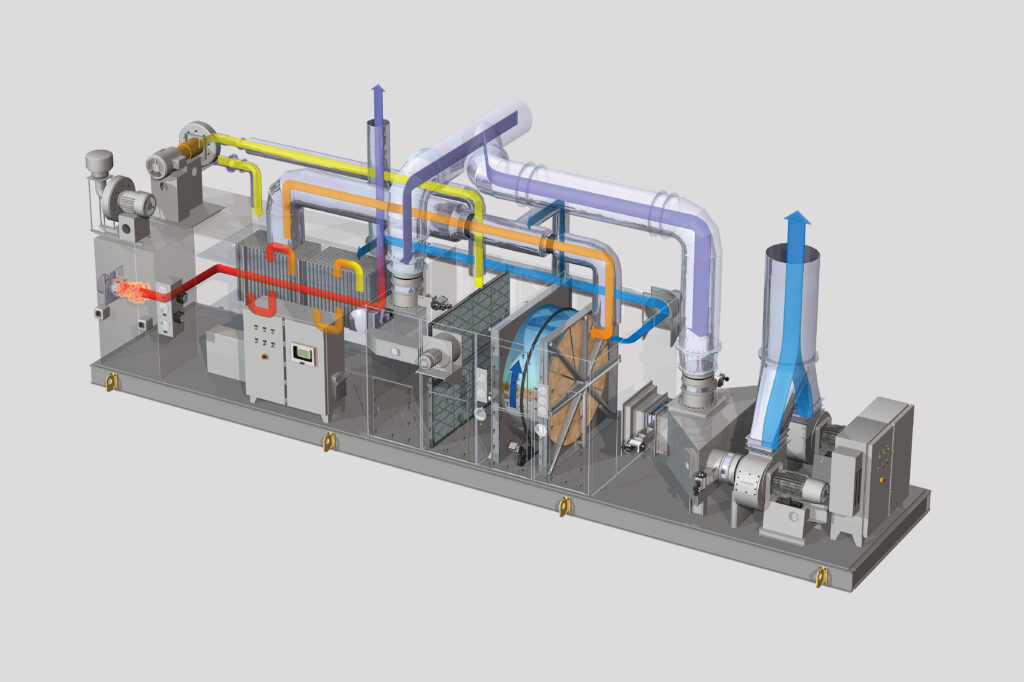
The rotor adsorbs compatible VOC compounds from the main exhaust stream. Heated air then desorbs the captured compounds into a smaller airflow, creating a more concentrated stream for further treatment.
This approach can reduce the volume of air requiring oxidation, but rotor material selection must account for the specific solvent mixture, humidity, temperature, and possible contaminants.
Regenerative Thermal Oxidation
Regenerative thermal oxidation uses high-temperature combustion to destroy many organic compounds. Ceramic heat recovery beds reduce the energy needed to heat incoming exhaust during operation.
RTO systems may be suitable for mixed-solvent streams when the compounds and operating conditions are compatible with the equipment.
The design should consider:
- VOC concentration and heating value.
- Required oxidation temperature and residence time.
- Exhaust airflow.
- Heat recovery performance.
- Combustion and safety controls.
- Potential formation of unwanted by-products.
Catalytic Oxidation
Catalytic oxidation uses a catalyst to promote the oxidation of VOCs, generally at lower temperatures than conventional thermal oxidation.
Its suitability depends on the solvent mixture and the presence of catalyst poisons or substances that may reduce catalyst activity. Certain compounds containing sulfur, halogens, silicon, or other catalyst-deactivating elements require careful evaluation.
Wet Scrubbing
Wet scrubbers transfer selected contaminants from an exhaust stream into a liquid. They can be useful for certain water-soluble compounds, acid gases, and process-specific pollutants.
However, many common organic solvents have limited water solubility. A conventional water scrubber should not be assumed to provide effective removal of every VOC in a mixed-solvent stream.
Step 4: Determine Whether Pretreatment Is Necessary
Pretreatment protects the main VOC treatment equipment and helps maintain stable operating conditions.
Industrial exhaust may contain dust, paint particles, oil mist, aerosols, moisture, or other contaminants. These substances can reduce adsorption capacity, block equipment passages, or interfere with catalytic reactions.
Depending on the exhaust characteristics, pretreatment may include:
Particulate Filtration
Suitable filters remove dust and suspended particles before the exhaust reaches adsorption or oxidation equipment.
Oil Mist Removal
Oil aerosols can coat activated carbon or rotor materials. Appropriate mist collection may be necessary in machining, coating, and other industrial processes.
Cooling and Condensation Management
Temperature adjustment may be needed when exhaust enters the treatment system at elevated temperatures or contains condensable substances.
Cooling must be carefully designed to prevent uncontrolled condensation, liquid accumulation, or corrosion.
Moisture Control
High humidity can affect certain adsorption processes. The need for moisture management should be determined through material compatibility and process evaluation.
Pretreatment should be selected according to actual contaminants rather than added automatically to every system.
Step 5: Design the Exhaust Collection and Ductwork
Even a suitable treatment unit may perform poorly if the exhaust collection system is incorrectly designed.
The ductwork should capture emissions near their sources and transport them to the treatment equipment without excessive leakage or unnecessary pressure losses.
Important design considerations include:
- Hood location and capture velocity.
- Duct diameter and airflow distribution.
- Fan capacity and static pressure.
- Corrosion-resistant construction where required.
- Condensate drainage and inspection access.
- Isolation dampers for individual production lines.
- Appropriate materials for solvent compatibility.
The collection system should maintain suitable negative pressure where necessary to reduce fugitive emissions. However, airflow must also remain within the operating range of the treatment equipment.
Step 6: Account for Variations in VOC Concentration
Mixed-solvent exhaust rarely remains constant throughout the production cycle. Concentrations can change when operators switch materials, start new production batches, clean equipment, or operate multiple lines simultaneously.
A system designed only for average conditions may struggle during peak emissions.
The design should therefore evaluate:
- Normal VOC concentration.
- Maximum expected concentration.
- Minimum operating concentration.
- Short-term emission peaks.
- Changes in solvent formulation.
- Simultaneous operation of production lines.
Where significant fluctuations occur, suitable control strategies may include airflow balancing, process scheduling, buffer arrangements, or automatic operating adjustments.
Any concentration or buffering approach must be assessed for safety, particularly where flammable solvents are involved.
Step 7: Integrate the Main Treatment Equipment With Control Systems
Automation helps maintain stable operation and supports early detection of abnormal conditions.
A modern VOC treatment system may include monitoring and control functions for:
- Exhaust airflow.
- VOC concentration or combustible gas levels.
- Equipment temperature.
- Pressure drop across filters and treatment units.
- Fan and motor operation.
- Rotor speed, where applicable.
- Oxidizer operating conditions.
- Emergency shutdown signals.
Control logic should coordinate the collection system, pretreatment equipment, and main treatment unit.
For example, an RTO should operate within its specified temperature and safety conditions before process exhaust is introduced. Similarly, adsorption systems should be monitored for pressure drop, temperature changes, and signs of breakthrough.
Alarm thresholds and shutdown procedures should be established through the system risk assessment and equipment specifications.
Step 8: Evaluate Energy Consumption and Operating Costs
The purchase price is only one part of the total cost of a VOC treatment system. Energy use, consumables, maintenance, replacement components, and production downtime can significantly influence long-term expenses.
Important cost factors include:
- Fan electricity consumption.
- Heating fuel or electrical energy.
- Activated carbon replacement or regeneration.
- Zeolite rotor maintenance.
- Catalyst replacement, where applicable.
- Filter and mist collector servicing.
- Inspection and monitoring costs.
- Equipment availability and downtime.
Heat recovery can improve the energy performance of oxidation systems. Zeolite rotor concentration may also reduce the airflow requiring high-temperature treatment in suitable applications.
However, the economic benefit depends on VOC loading, exhaust volume, operating schedule, and the efficiency of the complete system. Suppliers should provide estimates based on actual process data.
Step 9: Plan for Maintenance and Long-Term Performance
A treatment system requires routine inspection to maintain its intended performance.
Maintenance schedules should be based on equipment specifications, operating conditions, and measured performance trends.
Typical activities include:
- Inspecting filters and replacing them when necessary.
- Checking fans, motors, bearings, and drive components.
- Monitoring ductwork for leakage or deposits.
- Reviewing temperature and pressure readings.
- Checking activated carbon condition and breakthrough indicators.
- Inspecting zeolite rotors and sealing arrangements.
- Monitoring catalyst condition where catalytic oxidation is used.
- Testing alarms and protective devices.
- Verifying emission performance through suitable testing.
A reliable equipment supplier should provide operating manuals, maintenance procedures, troubleshooting support, and access to replacement parts.
Common Design Mistakes to Avoid
Several mistakes can undermine the performance and safety of a mixed-solvent VOC treatment system.
Selecting Equipment Based Only on Total VOC Concentration
Different solvents have different adsorption and oxidation characteristics. Total VOC concentration alone may not provide enough information for technology selection.
Ignoring Solvent Compatibility
Some compounds can damage adsorption materials or deactivate catalysts. Chemical compatibility should be checked before equipment selection.
Underestimating Peak Emissions
A system designed only for average airflow and concentration may not handle production peaks reliably.
Overlooking Pretreatment
Dust, oil mist, and aerosols can interfere with treatment equipment and increase maintenance requirements.
Neglecting Fire and Explosion Protection
Flammable solvent mixtures require a documented safety assessment and appropriate protective measures.
Focusing Only on Initial Equipment Cost
A low purchase price may result in higher energy consumption, frequent consumable replacement, or increased maintenance expenses.
Avoiding these mistakes helps businesses develop a treatment solution that is better aligned with both environmental and operational requirements.
Conclusion
Designing a VOC treatment system for mixed solvents requires a detailed understanding of exhaust composition, airflow, operating conditions, safety risks, and applicable emission standards. Activated carbon adsorption, zeolite rotor concentration, thermal oxidation, catalytic oxidation, and wet scrubbing each have specific applications and limitations.
The most suitable solution is often determined through a combination of emission testing, engineering calculations, technology evaluation, and safety assessment. By working with an experienced manufacturer and considering pretreatment, ductwork, automation, energy consumption, and maintenance from the beginning, industrial facilities can develop a more reliable VOC control system that supports consistent environmental performance and efficient operation.