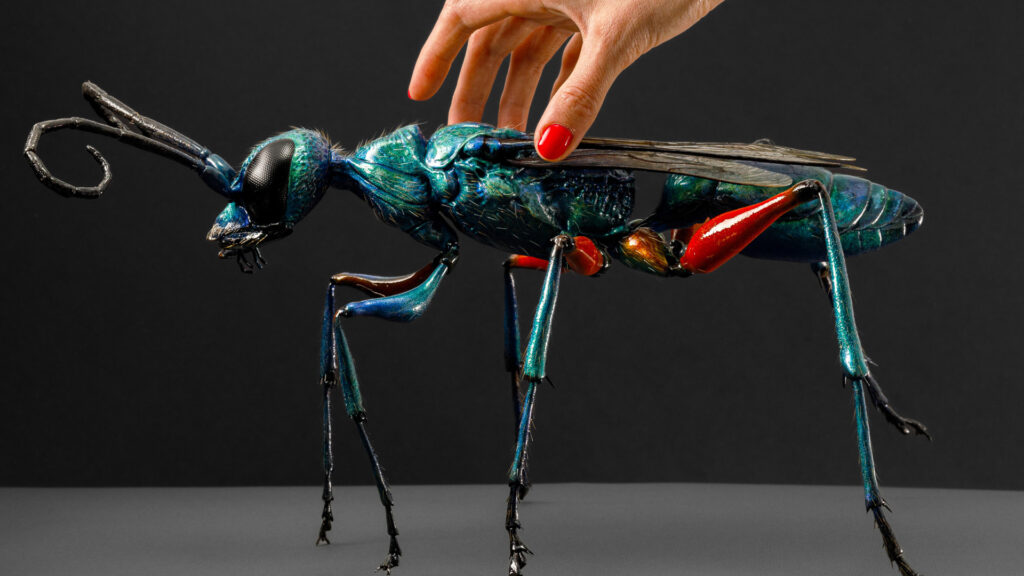
Realistic insect models are valuable tools for making science education more engaging, accessible, and memorable. By presenting insects in detailed three-dimensional forms, educators and exhibition designers can help visitors examine features that are often difficult to observe in nature. From the structure of a butterfly’s wings to the segmented body of an ant, these models turn complex biological details into clear visual learning experiences.
Whether used in school classrooms, natural history museums, science centers, or public exhibitions, high-quality Insect Models can help communicate important information about insect anatomy, biodiversity, habitats, and ecological relationships. Their realistic appearance encourages closer observation while providing a durable display option for environments where live specimens may not be practical.
Why Realistic Insect Models Matter in Science Education
Insects represent an enormous and diverse group of organisms. Their varied body structures, behaviors, and ecological roles make them an important subject in biology and environmental science education. However, small size and rapid movement can make many species difficult to study in ordinary classroom or exhibition settings.
Three-dimensional models address this challenge by allowing learners to examine insect structures at a comfortable viewing distance. Enlarged representations can make otherwise tiny details easier to recognize, including:
- Body segmentation: Understanding the head, thorax, and abdomen.
- Leg structure: Examining the number, position, and shape of insect legs.
- Wings and antennae: Comparing different forms and their functions.
- Mouthparts: Exploring how insects obtain and consume food.
- External features: Observing patterns, textures, colors, and protective structures.
These visual references can support lessons, guided demonstrations, and independent exploration.
Applications in Museums and Natural History Exhibitions
Museums use realistic insect models to present scientific information in ways that appeal to visitors with different levels of knowledge. A carefully arranged insect display can introduce unfamiliar species, explain evolutionary adaptations, and demonstrate the relationships between insects and their environments.
Models are particularly useful when an exhibition needs to highlight details that would be difficult to see through photographs or preserved specimens alone. For example, an enlarged bee model can illustrate the relationship between body structure and pollination, while a detailed butterfly model can help visitors understand wing patterns and anatomy.
Exhibition designers can organize models around themes such as:
- Insects found in forests, grasslands, and wetlands.
- Pollinators and their importance to plant reproduction.
- Insects that contribute to decomposition and nutrient cycling.
- Camouflage, mimicry, and natural defense mechanisms.
- The differences between major insect groups.
Adding informative labels, diagrams, and habitat backgrounds can make these displays more comprehensive and educational.
Design Features That Create Realistic Insect Models
The educational value of an insect model depends partly on how accurately it represents the appearance and structure of the subject. Careful attention to scale, proportions, surface details, and coloration helps create a convincing visual reference.
Accurate Body Proportions
Each insect species has distinctive physical characteristics. A model should represent the relative proportions of its body sections, legs, wings, and antennae as accurately as possible. Correct proportions help viewers distinguish between species and understand their anatomical differences.
Detailed Surface Textures
Insects have a wide range of external textures, from smooth wing surfaces to textured exoskeletons and fine body hairs. Reproducing these details can make a model more lifelike and provide additional opportunities for close observation.
Natural Coloration and Patterns
Color and markings are important identification features for many insects. Realistic models should use appropriate color combinations and patterns to represent the selected species. Accurate visual details also help explain warning coloration, camouflage, and mimicry.
Clearly Defined Anatomical Structures
Visible joints, segmented legs, wing veins, compound eyes, and antennae can make a model more useful as an educational reference. These features should be sufficiently defined to remain recognizable during classroom demonstrations and public exhibitions.
Choosing Materials for Educational and Exhibition Displays
Material selection affects a model’s durability, weight, finish, and suitability for different environments. The best choice depends on the intended application, display size, handling requirements, and expected lifespan.
Common considerations include:
| Design consideration | Why it matters |
|---|---|
| Durability | Helps models withstand repeated handling and long-term display |
| Weight | Makes installation, relocation, and transportation easier |
| Surface finish | Supports realistic textures and detailed coloration |
| Structural stability | Helps prevent damage or deformation during use |
| Maintenance | Makes cleaning and routine display care more manageable |
Models intended for interactive educational environments may require stronger construction and protective finishes. Museum displays, meanwhile, may prioritize fine surface details and a presentation quality that complements other exhibition elements.
Using Insect Models in Schools and Science Centers
In classrooms, insect models can support lessons about classification, anatomy, ecosystems, and environmental conservation. Teachers can use them to introduce new topics, reinforce textbook information, and encourage students to make observations.
For younger learners, brightly presented and clearly recognizable models can make biological concepts easier to understand. Older students may benefit from more detailed specimens that support comparisons between species and discussions of specialized adaptations.
Science centers can also incorporate insect models into interactive learning stations. Visitors might compare the body structures of different insects, identify visible anatomical features, or explore how specific species contribute to their ecosystems.
These activities encourage active participation rather than relying entirely on written explanations.
Creating Effective Insect Exhibition Layouts
A well-designed display should help visitors understand both the individual models and the broader scientific ideas they represent. Presentation choices can influence how easily people recognize important details and follow the exhibition’s educational message.
Consider the following approaches:
- Group models by biological characteristics: Arrange insects according to body structure, species group, or other relevant classifications.
- Use enlarged examples strategically: Feature larger models when small anatomical details are central to the learning objective.
- Provide clear information panels: Include common names, scientific names, habitats, and interesting biological facts.
- Add environmental context: Use background illustrations or miniature habitat elements to show where insects live.
- Allow comfortable viewing: Position models at suitable heights and provide enough space for visitors to examine them.
For interactive displays, designers should also consider visitor flow, accessibility, and the durability of models that may be touched regularly.
Custom Insect Models for Specialized Projects
Not every educational or exhibition project requires standard insect representations. Custom models can be developed to match a particular species, display theme, scale, or learning objective.
For example, a museum preparing an exhibition about pollination may need oversized representations of bees, butterflies, and other pollinating insects. A school science center might require a collection of common local species, while a natural history exhibition may focus on unusual anatomical features.
Customization can involve several design elements:
- Model dimensions and viewing scale.
- Species-specific body shapes and proportions.
- Color schemes and surface textures.
- Static or specialized presentation features.
- Mounting arrangements and display supports.
- Coordination with exhibition themes and educational materials.
Planning these requirements early helps ensure that the final models fit the available space and communicate the intended information effectively.
Maintenance and Long-Term Display Considerations
Proper maintenance helps preserve the appearance and condition of insect models, particularly in museums and educational facilities where displays may remain in place for extended periods.
Routine care should include checking for dust accumulation, loose components, surface damage, and changes in mounting stability. Cleaning methods should be appropriate for the materials and finishes used in construction. Harsh chemicals or abrasive tools should be avoided unless the manufacturer specifically confirms their suitability.
For traveling exhibitions, protective packaging and secure transportation arrangements are also important. Delicate antennae, wings, and other projecting structures may require additional protection to prevent accidental damage.
Conclusion
Realistic insect models provide an effective way to bring biological concepts into classrooms, museums, science centers, and public exhibitions. Their detailed structures make it easier for visitors to explore insect anatomy, recognize differences between species, and understand the ecological roles these organisms play.
By combining accurate proportions, carefully reproduced textures, appropriate materials, and thoughtful display planning, educational institutions can create engaging exhibits that encourage observation and scientific curiosity. Whether used as individual teaching aids or as part of a larger natural history collection, well-designed insect models can make the study of biodiversity more accessible and memorable.