Introduction
Alzheimer’s disease is a complex neurodegenerative condition associated with progressive changes in brain structure and function. Understanding the biological processes involved requires researchers to investigate molecular changes that may occur before, during, and after the development of clinical symptoms. Among the most widely studied molecular indicators are amyloid-beta and tau proteins, which provide complementary information about different aspects of Alzheimer’s-related pathology.
An integrated approach to the amyloid tau biomarker field helps researchers examine how these proteins relate to one another and how their measurement can support disease investigation. Amyloid and tau biomarkers are not interchangeable: they reflect distinct biological processes, and studying them together can provide a broader perspective than evaluating either group alone. Their combined analysis is therefore an important part of contemporary Alzheimer’s disease research.
Understanding Amyloid Biomarkers
Amyloid-beta is a peptide produced through the processing of amyloid precursor protein, a protein found in cell membranes. Under certain conditions, amyloid-beta peptides can accumulate and form aggregates, including the amyloid plaques commonly associated with Alzheimer’s disease.
Researchers investigate amyloid biomarkers to understand the production, clearance, and accumulation of amyloid-beta. These measurements can help characterize amyloid-related biological changes and explore their relationships with other disease processes.
Common Amyloid Biomarker Approaches
Several approaches are used to investigate amyloid-related changes:
- Amyloid-beta 42 (Aβ42): A peptide frequently studied because of its tendency to aggregate and its relationship with amyloid plaque formation.
- Amyloid-beta 40 (Aβ40): A more abundant amyloid-beta peptide often measured alongside Aβ42.
- Aβ42/Aβ40 ratio: A combined measurement that can provide additional information compared with either peptide concentration alone.
- Amyloid imaging: Imaging approaches, including positron emission tomography (PET), can help assess amyloid deposition in the brain.
- Cerebrospinal fluid analysis: Measurement of amyloid-related proteins in cerebrospinal fluid can provide information about changes associated with amyloid pathology.
The interpretation of these biomarkers depends on the sample type, measurement method, and research context. For example, the Aβ42/Aβ40 ratio is often investigated because it can help account for differences in overall amyloid-beta production and measurement.
Understanding Tau Biomarkers
Tau is a protein that helps stabilize microtubules, which contribute to the structure and transport functions of neurons. In Alzheimer’s disease, tau can undergo abnormal changes, including alterations in phosphorylation. These changes are associated with tau aggregation and the formation of neurofibrillary tangles.
Tau biomarkers are used to investigate these processes and explore how tau-related pathology develops in the nervous system.
Important Tau Biomarker Categories
Total tau (t-tau)
Total tau measurements reflect the overall amount of tau protein detected in a biological sample. In cerebrospinal fluid, elevated total tau can be associated with neuronal injury or degeneration, although it is not specific to Alzheimer’s disease.
Phosphorylated tau (p-tau)
Phosphorylated tau measurements focus on tau molecules modified at particular amino acid sites. Researchers commonly investigate p-tau 181, p-tau 217, and p-tau 231 because these forms have been associated with Alzheimer’s-related biological changes.
Tau imaging
Tau PET imaging uses specialized radiotracers to investigate the distribution of aggregated tau in the brain. This approach provides spatial information that differs from the concentration measurements obtained through blood or cerebrospinal fluid testing.
Together, these approaches help researchers study tau-related changes from different perspectives.
How Amyloid and Tau Biomarkers Complement Each Other
Amyloid and tau biomarkers reflect distinct but interconnected aspects of Alzheimer’s disease biology.
Amyloid-related measurements provide information about amyloid-beta production, clearance, and deposition. Tau-related measurements offer insight into changes in tau phosphorylation, aggregation, and associated neuronal processes.
Studying both groups can help researchers investigate several important questions:
- How do amyloid-related changes relate to tau pathology?
- Do changes in amyloid biomarkers occur alongside changes in phosphorylated tau?
- How are biomarker patterns associated with cognitive and neurological characteristics?
- Do amyloid and tau measurements change at different stages of disease development?
- Can combined biomarker profiles improve the characterization of research populations?
The relationship between amyloid and tau is complex. Amyloid accumulation may be associated with downstream changes in tau biology, but the timing and strength of these relationships can vary between individuals and research populations. Combined biomarker analysis helps researchers investigate these patterns without assuming that every participant follows the same biological sequence.
Major Methods for Measuring Amyloid and Tau Biomarkers
The selection of an analytical method depends on the target molecule, sample type, expected concentration, and research objectives.
1. Immunoassays
Immunoassays use antibodies to recognize specific proteins or peptides. They are widely used for measuring amyloid-beta, total tau, and phosphorylated tau in biological samples.
Common formats include enzyme-linked immunosorbent assays (ELISA) and chemiluminescence immunoassays (CLIA).
Important performance characteristics include:
- Analytical sensitivity.
- Analytical specificity.
- Precision and reproducibility.
- Detection and quantification limits.
- Cross-reactivity.
- Matrix interference.
- Calibration accuracy.
Antibody selection is particularly important for phosphorylated tau assays because the detection system must distinguish the intended phosphorylation site from other tau forms.
2. Chemiluminescence Immunoassays
Chemiluminescence immunoassays convert antibody-target recognition into a measurable light signal. Depending on the assay design, a labeled detection reagent participates in a chemical reaction that produces light.
An analyzer measures the emitted signal and uses calibration information to estimate the analyte concentration. Automated platforms can standardize operations such as reagent dispensing, incubation, washing, and signal measurement.
CLIA may be useful in biomarker research requiring quantitative measurements and consistent sample processing. However, each amyloid or tau assay must be independently validated for its intended application and sample matrix. Instrument availability alone does not establish compatibility with a particular assay.
3. Mass Spectrometry
Mass spectrometry provides an analytical approach based on the mass-to-charge characteristics of molecules or their fragments. It can be used to investigate specific amyloid-beta peptides and tau-related molecular forms.
Some mass spectrometry methods can distinguish molecular species that may be difficult to separate using antibody-based approaches. However, sample preparation, analytical complexity, instrumentation, and method validation are important considerations.
4. PET Imaging
PET imaging uses radiotracers that bind to particular pathological targets. Amyloid PET can help visualize amyloid deposition, while tau PET can provide information about the distribution of aggregated tau.
Unlike blood or cerebrospinal fluid assays, PET imaging offers spatial information about molecular pathology in the brain. However, it involves specialized equipment, radiotracer availability, and higher resource requirements.
The Importance of Sample Selection
Biomarker concentrations and their interpretation can vary according to the biological sample being analyzed.
Cerebrospinal Fluid
Cerebrospinal fluid (CSF) circulates around the brain and spinal cord. It provides a biological environment in which researchers can measure amyloid and tau proteins associated with central nervous system processes.
CSF analysis has been widely used in Alzheimer’s research, including the measurement of Aβ42, Aβ40, total tau, and phosphorylated tau. Collection procedures and sample handling must be standardized to reduce pre-analytical variability.
Blood-Based Samples
Plasma and serum are increasingly investigated as sources of Alzheimer’s-related biomarkers. Blood-based approaches may support larger studies and repeated sampling because collection is generally less invasive than lumbar puncture.
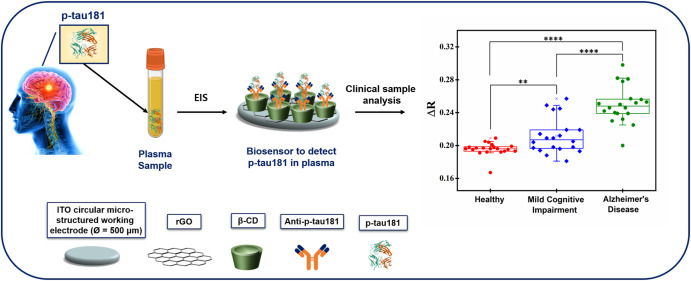
Researchers have examined plasma amyloid-beta ratios and phosphorylated tau forms, including p-tau 181 and p-tau 217. However, blood measurements can be affected by peripheral proteins, sample handling, and differences in assay sensitivity.
A blood-based biomarker should therefore be evaluated according to its specific analytical and clinical validation evidence rather than assumed to perform identically to a CSF or imaging method.
Factors That Influence Biomarker Measurement
Reliable biomarker research requires careful control of analytical and pre-analytical variables.
Antibody Specificity
Antibodies must recognize the intended target while minimizing cross-reactivity with related molecules. For amyloid-beta assays, researchers should consider peptide-specific recognition. For phosphorylated tau assays, antibody recognition of the relevant phosphorylation site is essential.
Analytical Sensitivity
Some biomarkers occur at low concentrations, particularly in blood samples. An assay must have adequate sensitivity for the intended sample type and research question.
Important parameters include the limit of blank, limit of detection, and limit of quantification. These values should be established through appropriate validation studies.
Sample Handling and Storage
Collection tubes, processing delays, storage temperature, and freeze-thaw cycles can influence biomarker measurements. Laboratories should use consistent protocols and document deviations that may affect results.
Calibration and Quality Control
Calibrators establish the relationship between assay signals and assigned analyte concentrations. Quality-control materials help monitor performance over time and identify unexpected changes.
Laboratories should review control results, monitor reagent lot changes, and maintain records of calibration and instrument maintenance.
Matrix Effects and Interference
Biological samples contain substances that may interfere with antibody binding or signal generation. Matrix-specific studies, dilution assessments, and spike-and-recovery experiments can help identify these effects.
Combining Biomarker Results for Research Interpretation
The value of combined amyloid and tau analysis lies in the different biological information each marker contributes.
For example, researchers may examine amyloid-related measurements alongside phosphorylated tau to investigate whether amyloid accumulation is associated with changes in tau biology. They may also compare biomarker patterns with cognitive assessments, imaging findings, or longitudinal observations.
A structured interpretation approach can consider:
- Amyloid status: Whether measurements indicate patterns consistent with amyloid-related changes.
- Tau status: Whether phosphorylated or total tau measurements suggest changes in tau-related biology.
- Neurodegeneration-related evidence: Whether additional biomarkers or imaging findings indicate neuronal injury or structural changes.
- Clinical context: How biomarker patterns relate to participants’ cognitive and neurological characteristics.
- Longitudinal information: Whether repeated measurements reveal changes over time.
The widely used AT(N) research framework groups biomarkers into amyloid (A), tau (T), and neurodegeneration or neuronal injury (N) categories. It provides a way to organize biological evidence in Alzheimer’s research, although the specific markers and methods used can vary between studies.
Challenges in Amyloid and Tau Biomarker Research
Despite advances in analytical technology, several challenges remain.
| Research challenge | Why it matters | Potential approach |
|---|---|---|
| Low biomarker concentrations | Can limit reliable quantification | Validate analytical sensitivity |
| Differences between assay platforms | May reduce comparability | Conduct method-comparison studies |
| Sample-related variability | Can affect measured concentrations | Standardize collection and storage |
| Cross-reactivity | May produce misleading signals | Evaluate antibody specificity |
| Complex disease biology | Biomarker patterns may vary | Combine complementary measurements |
| Longitudinal variation | Can complicate trend analysis | Use consistent methods and protocols |
| Limited standardization | Can affect multi-center studies | Establish shared procedures and quality controls |
Addressing these challenges is important for producing reproducible findings and improving comparisons across research institutions.
Emerging Directions in Alzheimer’s Biomarker Investigation
Research into amyloid and tau biomarkers continues to develop alongside improvements in analytical platforms and molecular characterization.
Blood-Based Biomarker Development
Blood-based amyloid and phosphorylated tau measurements are receiving considerable research attention. Their potential use in large-scale studies may support participant screening, longitudinal monitoring, and investigation of disease-related biological patterns.
Further work is needed to establish appropriate thresholds, assess performance across populations, and understand how results relate to other biomarker methods.
Multiplex Biomarker Analysis
Multiplex technologies aim to measure several biomarkers within a single sample or analytical workflow. Measuring amyloid, tau, and additional proteins together may help researchers explore interactions among different biological processes.
Such approaches require careful validation of each analyte, including assessment of cross-reactivity and potential interference between assay components.
Improved Analytical Platforms
Advances in immunoassay design, detection chemistry, automation, and mass spectrometry may improve the sensitivity and consistency of biomarker measurement.
Nevertheless, improvements in instrumentation must be supported by rigorous assay validation. Reproducible measurements depend on the complete analytical system rather than a single technological feature.
Conclusion
Amyloid and tau biomarkers provide complementary insights into the molecular processes associated with Alzheimer’s disease. Amyloid-beta measurements help researchers investigate amyloid-related changes, while total and phosphorylated tau measurements provide information about tau biology and associated neuronal processes.
Combining these biomarkers can support a broader investigation of disease mechanisms, biomarker relationships, and changes across research populations. Achieving meaningful results requires suitable sample selection, validated analytical methods, consistent laboratory procedures, and careful interpretation of the available evidence.
As blood-based testing, immunoassay automation, imaging, and molecular analysis continue to advance, integrated amyloid and tau research will remain an important part of efforts to understand Alzheimer’s disease. These approaches contribute to scientific investigation and biomarker development, while clinical conclusions must continue to rely on appropriately validated methods and the full clinical context.